



Introduction
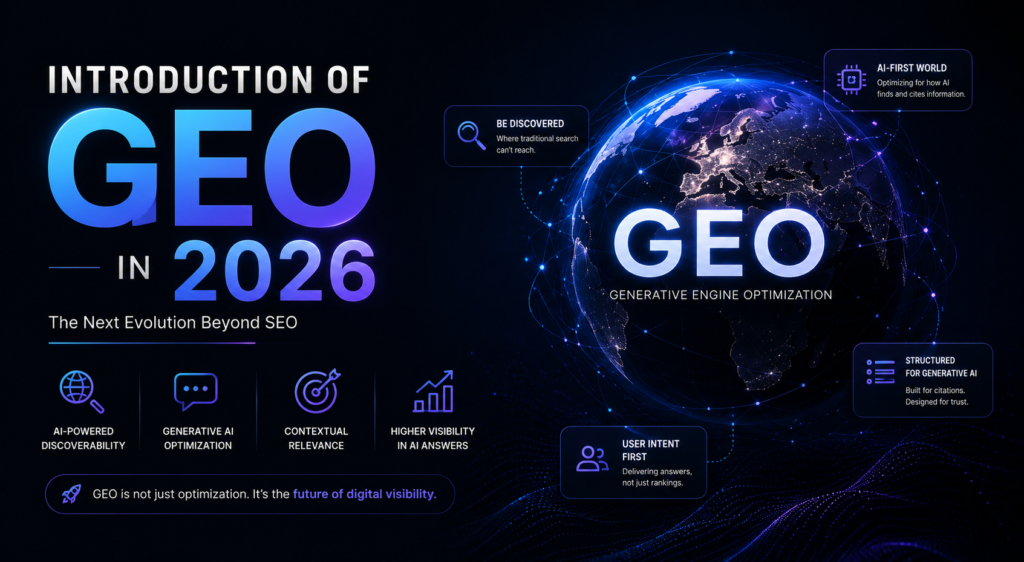
Generative Engine Optimization in ,digital marketing is evolving at a record pace. The primary strategy used by most companies in the past was traditional SEO optimization, which helped businesses get higher rankings in search engines. But the search process has been undergoing significant transformation due to the rising popularity of AI-powered search platforms.
Modern users not only look for information using Google search but also ask their questions to AI platforms like ChatGPT, Gemini, and many other AI-powered search services. Such search platforms offer immediate answers rather than links to various websites. That is why modern businesses should apply an alternative strategy for optimizing the content. Another emerging trend that is transforming digital marketing is Visual Search Marketing. You can read our detailed guide on The Rise of Visual Search Marketing to learn how image-based search technologies are helping businesses improve product discovery, customer engagement, and online visibility in 2026.
If you have already seen our previous blog post on AI email marketing tools in 2026, then you can easily understand how AI has transformed the digital marketing world. GEO is one of the promising strategies that will help you attract more users in 2026.
What is Generative Engine Optimization?
Generative Engine Optimization (GEO) refers to the process through which websites optimize their content to enable AI search engines to understand, trust and use their data when creating answers for users. As opposed to traditional SEO, which involves ranking web pages, GEO ensures that the content is used to create responses.
As the AI search engines continue to expand and increase, companies are becoming interested in GEO marketing since they can keep their websites visible to modern search engines. This is why several marketers have started researching AI search engine optimization.
Why is Generative Engine Optimization Rising in 2026?
One of the main reasons driving GEOis the increasing trend of AI searches. The new generation of users expects to receive fast and relevant results without browsing through various websites. Through AI technology, information from various sources is analyzed and complete answers are created within a few seconds.
The above trend can also be associated with Google AI Overview SEO, where Google offers users an AI-powered summary right inside the search result page. Due to such changes, businesses using traditional SEO may experience problems and become invisible unless they start using AI SEO strategies.
In addition, one of the key factors driving GEO SEO is related to voice search, AI assistants, and conversational search experience. Nowadays, users tend to ask complex queries and get comprehensive answers from AI, and therefore content quality has become extremely crucial.
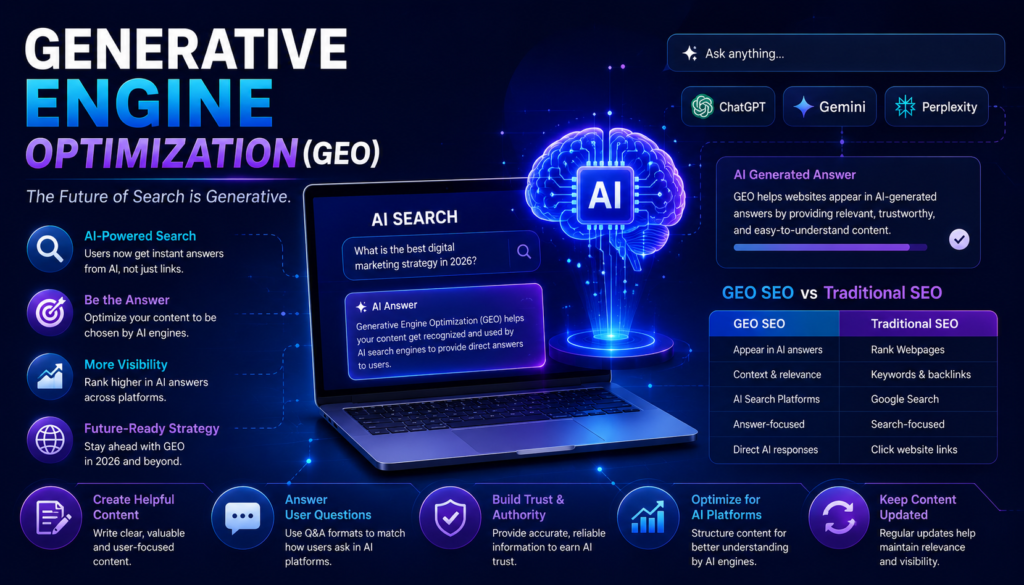
GEO SEO vs Traditional SEO
| Feature | Traditional SEO | GEO SEO |
| Main Goal | Rank Webpages | Appear in AI answers |
| Focus | Keywords & backlinks | Context & relevance |
| Search platform | Google Search | AI Search Platforms |
| Content Style | Search-focused | Answer-focused |
| User Experience | Click website links | Direct AI responses |
This comparison clearly shows why GEO is becoming a major part of modern digital marketing strategies.
How to Do Generative Engine Optimization
Many companies are wondering about how to do Generative Engine Optimization efficiently. First and foremost, one needs to create top-notch content that would provide an answer to the user’s query.
Some important Generative Engine Optimization strategies include:
- Writing clear and helpful content
- Using question-and-answer formats
- Creating trustworthy information
- Improving website authority
- Updating content regularly
- Using structured headings and subheadings
These GEO strategies help AI systems understand content more effectively and increase the chances of appearing in AI-generated responses.
Generative Engine Optimization Examples
There are many real-life Generative Engine Optimization examples. For instance, the publication of thorough guides, answering frequently asked questions, and offering valuable information on a website will increase chances of appearing in AI-generated responses.
When creating SEO, content marketing, and AI search related guides and presenting them in a structured way, a digital marketing agency will be selected by AI searches. That is the reason why GEO AI search has become one of the most important topics for marketers around the world.
Moreover, the writing of detailed comparison articles, FAQs, case studies, and educating content solving user problems may increase the probability of being chosen by AI platforms because of providing complete solutions.
Generative Engine Optimization Tools
There are many ways to optimize content through Generative Engine Optimization techniques. To do so, several GEO tools can be used for research and content analysis.
Some commonly used tools include:
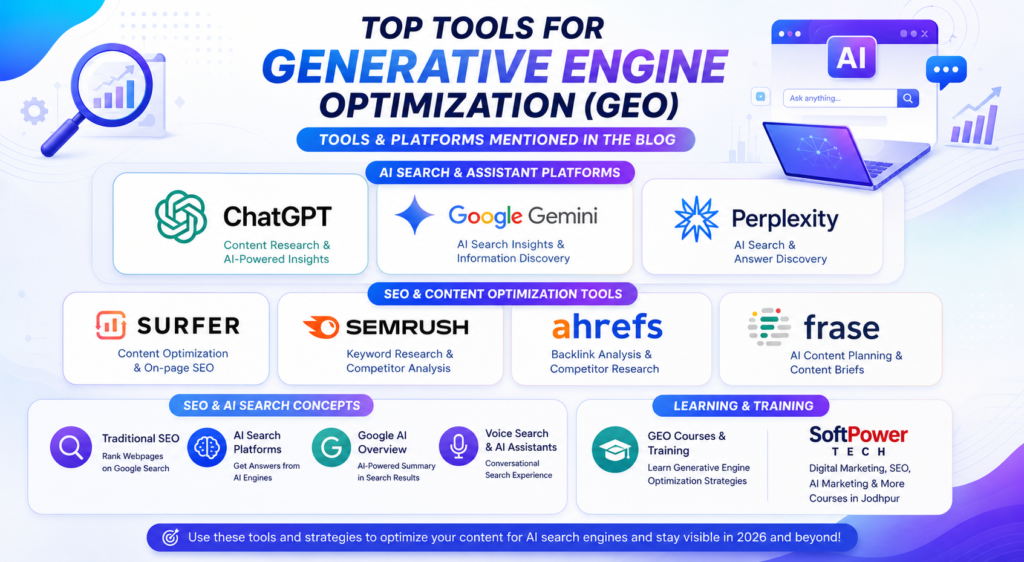
| Tools | Purpose |
| ChatGPT | Content research |
| Google Gemini | AI search insights |
| Surfer SEO | Content optimization |
| Semrush | Keyword research |
| Ahrefs | Competitor analysis |
| Frase | AI content planning |
Using these Generative Engine Optimization tools can help businesses create content that performs better in both traditional search engines and AI search platforms.
Generative Engine Optimization Course and Learning Opportunities
With the expansion of AI search, marketers are seeking Generative Engine Optimization training to understand the latest trends in search marketing. Studying about GEO would help marketers, students, and businesses prepare for the future of search.
In Jodhpur, SoftPower Tech offers training courses in digital marketing, SEO, AI marketing, content marketing, and the new search methods. Students get to learn about the role of SEO for AI search in boosting the visibility of businesses on AI-powered search engines.
This also teaches students about the application of GEO marketing AI and content optimization in the future.
The Future of GEO Marketing
One can expect that the future of GEO marketing will be really promising due to the increasing popularity of AI searches every year. Businesses that embrace GEO now can get ready for upcoming transformations.
Experts say that AI ranking is becoming more and more important because more and more people use the answers created by AI instead of the usual search results. Thus, businesses need to use not only SEO but also AI search engine optimization.
Further development of AI will bring up the importance of using GEO AI search strategies for successful marketing plans.
Conclusion
Generative Engine Optimization has changed the principles that businesses used for online promotion. Now, apart from SEO, companies have to pay attention to AI search optimization.
Using Generative Engine Optimization techniques effectively, creating quality content, and mastering AI-powered search optimization techniques will increase businesses’ chances to rank in modern-day searches. With the advancement of digital marketing through the aid of artificial intelligence, Generative Engine Optimization is set to be one of the crucial abilities for marketers in 2026.
FAQs
1. Why is Generative Engine Optimization important in 2026?
Generative Engine Optimization is important because more users are getting answers from AI search platforms instead of clicking on traditional search results. GEO helps content appear in these AI-generated responses.
2. Can GEO help improve AI search visibility?
Yes, GEO helps improve AI search visibility by making content easier for AI systems to understand, trust, and include in their generated answers.
3. Which businesses can benefit from GEO marketing?
E-commerce stores, service providers, educational websites, bloggers, and digital marketing agencies can all benefit from GEO marketing strategies.